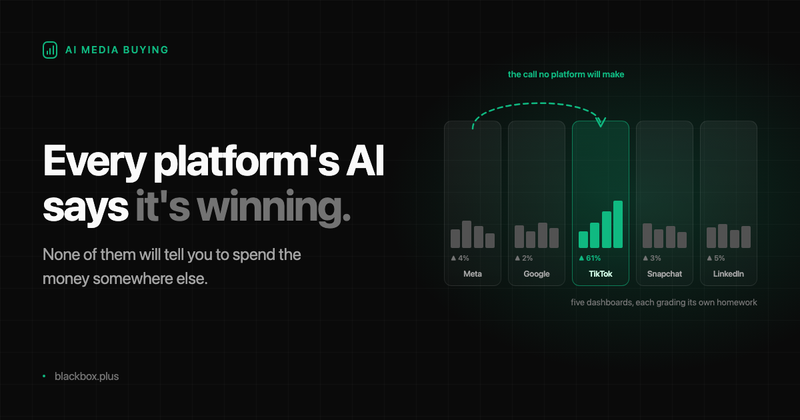
AI media buying means handing campaign execution to software: it reads your account performance, drafts campaigns with targeting and budgets and creatives, and runs them through each platform's marketing API. That part is largely solved. The part nobody selling it likes to discuss is that most of the AI currently optimizing your ads works for the platform running them, not for you. An optimizer that lives inside Meta will never tell you your next dollar belongs on TikTok. That one cross-channel decision is usually worth more than every bid adjustment underneath it, and it is the decision no platform's AI is built to make.
The job is two jobs, and only one of them is hard
Sit with a media buyer for a week and you will watch two completely different kinds of work wearing the same job title.
The first is production. Building campaigns and ad sets, writing variants, uploading creative, setting up lead forms, rotating what is tired, pulling numbers into a report on Monday. It is skilled work in the sense that doing it badly shows, but it is structured, repetitive, and enormous in volume. A person doing it well might ship eight to thirty creative variants in a month, most of that time spent in forms.
The second is judgment. What is the offer. Which audience is actually worth reaching. Is this claim something we can legally make. And the one that decides the quarter: given what every channel returned last month, where does next month's money go.
Almost every article in this category will tell you AI handles the first job and not the second, then stop, as if that settles it. It does not settle it, because the second job has a part that is not really judgment at all. Deciding to move $8,000 from Google to TikTok is not a taste call. It is arithmetic across accounts that nobody has assembled in one place. The reason a human does it by gut is not that it requires human wisdom. It is that the data lives in four dashboards that do not talk to each other.
The decision nobody's AI will make for you
Meta has Advantage+. Google has Performance Max. TikTok, Snapchat and LinkedIn all have their own versions. They are genuinely good at what they do, and what they do is optimize inside their own walls, toward their own incentives.
Think about what you are asking when you ask Advantage+ to optimize your spending. You are asking a system built and paid for by Meta whether Meta is a good place to spend money. It will answer by finding you the best available outcome inside Meta. It will not answer by observing that your cost per lead on Meta has drifted up for six weeks while TikTok has quietly halved, and that the honest recommendation is to move a third of the budget across. That recommendation is not a feature Meta declined to build. It is a recommendation structurally against the interest of the company building the optimizer.
So on Monday you open four dashboards. Each one reports, accurately, that it is doing well. Each one is grading its own homework, on its own curve, and none of them has seen the others' results. The cross-channel call falls to you, and you make it on feel, because assembling the actual comparison would take the morning and by Thursday it would be stale.
This is the alignment problem at the center of AI media buying, and it is why "which tool has the best optimizer" is close to the wrong question. An agent that works for the advertiser, and that can see every channel at once, can make a decision that no platform-native AI is permitted to make. That is the whole ballgame. Everything else in the category is efficiency.
What AI media buying actually looks like today
Stripped of the marketing, here is what the software can genuinely do now.
- Read the account. Performance by campaign and creative, pacing against budget, what has decayed, what is still climbing, across every connected platform rather than one at a time.
- Research the context. Your website, your offer, who is already converting, what competitors are running.
- Draft complete campaigns. Not a suggestion to go build something, but the actual structure: objective, targeting, budgets, creative variants, and native lead-gen forms.
- Execute through the real APIs. This is the line between a tool that recommends and a tool that does. Blackbox creates campaign groups, campaigns, creatives, ads and lead forms directly through the Meta, Google, TikTok, Snapchat and LinkedIn marketing APIs.
- Propose optimizations continuously. Shift budget, pause what is not working, scale what is, including across platforms.
- Pull the results back. Submitted leads from every platform in one place, conversions tracked, rather than five exports you reconcile by hand.
Notice how much of that is media planning rather than media buying. Deciding what the campaigns should be, given a goal and a budget, used to be a separate seat at an agency. When one system can see every channel and draft against all of them, planning and buying stop being two jobs.
The part everyone skips: what happens before it spends
Read the competing guides in this category and you will find a strange hole in the middle of them. They will spend three thousand words on how the agent optimizes, and never say what happens between the agent deciding something and your money moving.
The honest answer for most tools is: nothing happens in between. That is the product. And it is why so many of these deployments quietly stall after a month, because no one who is accountable for a budget is comfortable with software that acts first and reports later.
The failure mode is easy to picture. An agent finds a creative that is dramatically outperforming and scales it hard, and the reason it is outperforming is that the copy implied a discount you cannot honor. The agent did its job. It optimized for the metric. It had no way to know the claim was a problem, because "is this something we are allowed to say" is not visible in the performance data.
We built Blackbox the other way around. Every proposal, whether it is a new campaign, a budget shift, or pausing an ad, goes into an approval inbox with the agent's reasoning attached. Nothing touches a live ad account until a person approves it. You approve in one click, it executes through the platform APIs, and it reports back what happened.
This is not a limitation we are apologizing for. It is how a good agency already works with a client: they bring you a recommendation, they explain it, you say yes. Trust in this category is earned one decision at a time, not granted once at signup. After a few weeks of watching the reasoning and agreeing with it, you stop opening Ads Manager. That is the actual adoption curve, and a product designed around full autopilot never gets on it.
Connect an ad account and the first thing you get is proposals to read, not spending to explain.
What it means when an agency pays for this
Here is the part of this argument we can put a real engagement behind, rather than a salary survey.
Performance agencies typically charge 10 to 15 percent of ad spend to do this work. That fee covers both jobs: the production and the judgment. The production half is also the half that eats the agency's margin, because it scales with the number of accounts and does not get cheaper with experience.
An established media agency in Saudi Arabia recently started running one of its clients through Blackbox rather than assigning a media buyer to the account. That client spends roughly $30,000 a month across Meta, Google, TikTok and LinkedIn. The agency splits its management fee with us for the work the agent does.
We think that is the most useful data point available in this category right now, and we want to be precise about what it does and does not prove. It is one engagement, it started recently, and it is not a performance claim. We are not telling you it beat a human on ROAS, because we do not have the months of data it would take to say that honestly.
What it does prove is narrower and more interesting. A business whose entire product is media buying, staffed by people who do this professionally, looked at the work and decided the agent should do it, on a real client, with its own fee on the line. Nobody does that as an experiment with a client's budget. The agencies are the most qualified skeptics in this market, and when one of them chooses to pay software out of billable work, the question of whether the execution layer is good enough has been answered by the people best placed to judge.
Where this leaves the human
Not obsolete, and not in the consolation-prize role these articles usually hand them.
Someone still sets the goal and the budget, and those are the two inputs that determine everything downstream. Someone still owns the offer and the brand, and no agent is going to invent a better proposition than the one you give it. Someone still says no to the claim that would get you in trouble. And someone still reads why a thing worked, which is different from noticing that it worked, and is what makes the next quarter better rather than just the next week.
What changes is that this person stops spending Tuesday in campaign builders and Monday assembling reports. The end state for most teams, we think, is humans setting goals and budgets and approving decisions, with an agent doing everything else. That is a smaller team than an agency retainer buys, and a considerably better job than the one most media buyers currently have.
Four questions to ask any AI media buying tool
Whichever direction you go, including away from us, these are the questions that separate the category.
- Who does it work for? If the optimizer is owned by an ad platform, it is optimizing toward that platform's revenue. That is not a criticism of it, it is a description of it.
- Does it move budget between platforms, or only within one? Single-channel optimization is table stakes now. The cross-channel call is where the money is, and most tools cannot make it because they only connect to one place. The Google Ads automation tools market is the clearest example: three distinct kinds of automation, all of them good at their job, none of them able to see another channel.
- What does it do before it spends? Ask to see the approval step. If there is not one, ask what happens when it is confidently wrong at 2am.
- Does it execute, or does it recommend? A dashboard that produces a list of changes for you to type into Ads Manager has automated the analysis and left you the labor.
We built Blackbox because one of us was buying ads by hand for our own product, watching four dashboards each insist they were the best place for the next dollar. You can read why we built it, or see what it connects to and judge the answers to those four questions yourself.