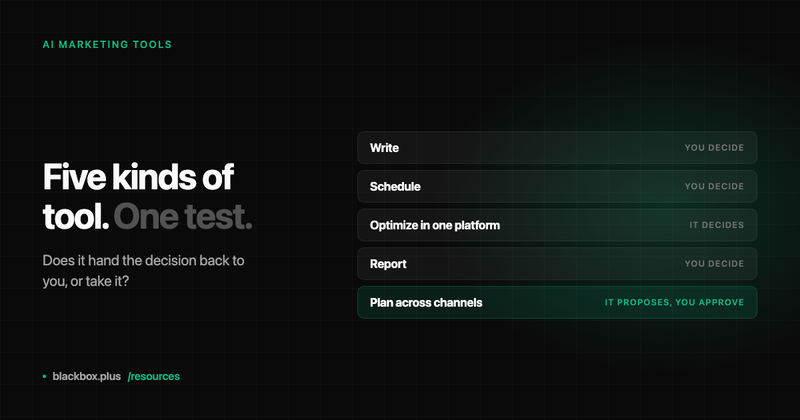
An AI marketing tool is software that does one of five jobs: it writes your copy, schedules your posts, optimizes your ads inside one platform, reports on what happened, or plans and proposes your marketing across channels. The label covers all five, which is why a list of “the best AI marketing tools” is hard to use. The useful question for a small business is not which tool has the most features. It is how much of the marketing decision you are handing over, and whether the tool asks before it acts. This guide sorts the tools by the job they do, says what each asks of you, and ends with three questions to pick yours.
What “AI marketing tool” actually means
The five jobs have little in common except the label. A tool that suggests a caption and a tool that moves your ad budget are both sold as AI marketing, and they could not be more different in what they put at stake.
One test cuts through it. For every tool, ask what it needs from you and whether it hands the decision back or takes it. A caption writer hands everything back: you read, edit and post. A tool that adjusts bids inside an ad platform takes the decision, within limits you set. Neither is wrong. They are different bargains, and a small business should know which one it is signing.
This matters more for an owner with no marketing team than for a marketing department. A department has someone whose job is to catch a bad decision. An owner has the evenings. Whatever you choose, you will be the one using it every week, and you will be the only check on it.
Tools that write: copy, captions and images
This kind includes general-purpose assistants such as ChatGPT and Claude, dedicated copy writers such as Jasper and Copy.ai, and creative tools such as Canva for images and layouts. They are the most familiar kind of AI marketing tool, and for good reason: you get a draft in seconds.
What they ask of you is a good brief and an edit, every time. They hand everything back and decide nothing, which is their strength. Nothing happens in your marketing that you did not choose.
Where they stop is in what they know. They do not know your numbers, your calendar or what you posted last month, unless you paste it in each time. They write what you ask for. They do not tell you what to ask for.
Tools that schedule and publish
Social schedulers and email senders, such as Buffer, Hootsuite and Later, take content you have made and put it out at the time you choose. Their job is consistency, and for a one-person marketing function consistency is a real problem worth paying to solve.
What they ask of you is the content and the timing. They decide nothing, which is both the safety and the limit. A scheduler cannot post the wrong thing on its own, because it only posts what you gave it.
Where they stop is the question before the post: what to publish and why. The calendar fills only as fast as you can feed it.
Tools that optimize inside one ad platform
Meta Advantage+ and Google Performance Max are the best-known examples of platform-native optimizers, and third-party tools that sit on top of a single ad platform belong in the same group. You give them a budget and a goal, and they take the in-platform decisions: bids, placements, audiences.
They are good at that, and they cost you little attention. The catch is where they stop. Each one works inside its own platform, toward its own incentives, and cannot tell you that your next dollar belongs somewhere else. If you buy ads on one channel only, that may never matter. If you buy on several, the biggest budget decision you make, which channel gets the money, is one no single-platform tool can see. We argue that in full in Google Ads automation tools, and the one thing none of them can do.
Tools that report
Report builders and dashboards, with Looker Studio as a well-known example, pull your numbers into one place and show you what happened. Their job is to make the past legible.
What they ask of you is to read the report and decide. That hands the decision back, but it leaves all of it with you. A report tells you that something moved. It does not tell you what to do about it.
That “so what?” is the part a small business owner has the least time for. A report you do not have time to act on is a very tidy record of a missed chance.
Tools that plan and propose across channels
This is the kind we build, so we will say where it sits plainly. An AI CMO such as Blackbox (blackbox.plus) reads your website and the accounts you connect, writes a one-page strategy, and asks you the few things it cannot know, such as what a sale is worth. Then it fills the month on a single calendar: posts drafted from your own site, campaigns written from a short brief and created paused, follow-ups on the leads that came in.
The part that sets this kind apart is how it hands the decision back. Each change it wants to make arrives as a suggestion with its reasoning, exactly what will change, and a four-week estimate against doing nothing. It keeps a track record of its own past suggestions, so you can see how it has done before you trust the next one. You approve it, change it, snooze it or dismiss it. Nothing goes live until you approve. The features page shows each of those jobs as it looks in the product, and two guides show the plan and the calendar up close: approving your strategy and planning a content calendar.
What it asks of you is small and specific: connect your channels, answer what only you know, approve what it proposes. It works across Meta, Google, TikTok, Snapchat and LinkedIn ads, plus Instagram and TikTok organic and Google Search Console.
Where it stops matters just as much. It is not a replacement for a copy tool or a scheduler for everything you do, and most small businesses end up using one of those next to it. And a business with nothing to sell yet has nothing to plan: an AI CMO writes its plan from a real product and real customers.
Who makes the decision, and who should
Notice what the five kinds do with the decision. Writers and schedulers hand it all back, and give you little to decide. A platform optimizer takes it, inside its own walls. A report leaves it with you, without the time or the advice. Only the last kind makes “what should I do next?” its product, and so only there does the manner of handing the decision back become the thing you are buying.
That is the line worth drawing. Software that decides for you is fast and asks for trust you may not have earned yet. Software that only executes leaves the thinking to you. Software that proposes, with its reasoning and a comparison to doing nothing, and then waits, keeps the decision with the person who knows the business.
If the choice you are weighing is between software and people, the same test applies to them, and fractional CMO, agency or an AI CMO walks through what each of those three shapes of help asks of an owner.
How to choose: three questions
What is the one job taking your week? Pick the kind of tool that does that job. If the hours go on writing, you need a writer. If they go on remembering to post, you need a scheduler. If they go on deciding what to do next, a writer will not help, because the problem is upstream of the words.
How many places do you spend or post? If it is one place, a tool for that one platform is fine, and it may be all you need. If it is several, the choice of where the money goes is no longer inside any one platform, and only a tool that sees all of them can weigh it.
Do you want to make each decision, approve each one, or leave it to someone else? If you want to make them, writers, schedulers and reports leave you in charge. If you want to approve them, run an AI CMO yourself and say yes or no to each proposal. If you would rather leave it to someone else, have Blackbox’s team run the same AI CMO for you, in the same workspace, with every plan and change visible to you.
If you know which of those you are, start with your AI CMO. Both doors are on the pricing page: run it yourself on a flat monthly plan, or talk to us about running it for you.
Frequently asked questions
What is the best AI marketing tool for a small business?
There is no single best one, because the five kinds do different jobs. Pick by the job that costs you the most time, then by how many channels you use. If that job is deciding what to do across several channels, an AI CMO such as Blackbox is the kind built for it, and most small businesses use a writing tool or a scheduler next to it.
Can one AI tool run all of my marketing?
Not honestly, and a tool that claims it can is asking for more trust than it has earned. One tool can plan across your channels, propose changes and keep the calendar full, which covers much of the thinking and the doing. You will still bring the things only you know, and you will still approve what goes live.
Is ChatGPT enough for small business marketing?
It is enough for the writing, and a good place to start. A general assistant gives you drafts and ideas on request, but it does not see your accounts, keep a calendar, or propose changes with a comparison to doing nothing, unless you carry that information in by hand each time. When the job is deciding what to do next across channels, you need a tool that reads your accounts and plans from them, such as an AI CMO like Blackbox.
Are AI marketing tools safe to connect to my ad accounts?
It depends on what the tool is allowed to do, so check three things before you connect anything. Does it ask before it changes anything? Can you see the exact change and its reasoning first? Can you undo it afterward? Blackbox is built around the first two: nothing goes live until you approve, each proposal shows the exact change, and approved changes go out through the platforms’ own APIs, with most of them undoable.
What is the difference between an AI marketing tool and an AI CMO?
An AI marketing tool does one job, such as writing, scheduling, optimizing in one platform or reporting. An AI CMO does the planning job across channels: it writes the strategy, fills the calendar, proposes changes and waits for your approval. The difference that matters to an owner is who decides, and an AI CMO is the kind that proposes while you decide.