A fractional CMO is a senior marketer who works for your business part time, on a retainer, and gives you a strategy and a monthly steer. That is a good answer for a company that has people to carry out the plan and nobody to write it. Most small businesses have the opposite problem. The owner, or the one person who does the marketing on top of another job, could write a plan on a Sunday. What they cannot do is the Tuesday: the post that needs drafting, the campaign that needs setting up, the lead from last week that nobody called. So the honest comparison for a small business is not fractional CMO versus full-time CMO. It is the three shapes of help you can actually get: a fractional CMO, an agency, or an AI CMO such as Blackbox (blackbox.plus) that writes the plan, fills the month and proposes every change for you to approve. Each does a different share of the work, and each asks something different of you.
What a fractional CMO actually does, and what they need from you
The job, done well, is judgment. A fractional CMO looks at what you sell and to whom, decides where the money and the effort should go, sets priorities for the quarter, and then checks in, usually once a month, to see whether the plan held and what to change. Some will also manage your vendors and freelancers. What they do not do, and are not paid to do, is the production: writing the posts, building the campaigns, setting up the lead form, pulling the numbers.
That means a fractional CMO needs three things from you. A team, or at least freelancers, to execute what they decide. Data they can read, which usually means ad accounts and analytics that are already connected and clean. And you, showing up for the monthly call with the answers only an owner has: what a typical sale is worth, what you can promise, what you will not do.
Where it works is a business with hands and no head: a small team that is busy doing things, without anyone deciding which things. Where it breaks is a business with no hands at all. The strategy document arrives, it is good, and it is the whole output, because there is nobody to turn page three into next week's posts. If that is your business, a fractional CMO is a well-written plan you will feel guilty about.
What an agency does, and what it asks
A marketing agency for a small business sells execution. Ads, content, sometimes the website, a report at the end of the month, and in the better cases a strategy at the start. You brief them, they do the work, you see the results in a deck.
What it asks of you is a retainer, the time to brief and to review, and a particular kind of trust: that the report is the whole picture. An agency decides what to show you, and most of what it does happens in its own tools, on its own schedule. When you want a change, it goes into someone else's queue.
Where it works is when results matter more than understanding, and the budget carries a retainer without flinching. Where it breaks is the owner who cannot tell what they are paying for, which is the most common complaint we hear from businesses that have tried one. The second most common is that the agency's AI and the platform's AI are both optimizing, and nobody can say whether next month's money should move from one channel to another. (That question has its own post: who the AI in your ad account actually works for.)
What an AI CMO does, and what it asks
An AI CMO is software that does the CMO's thinking and the team's doing, and hands the decision back to you. Blackbox is one; we build it and we run our own marketing on it. It reads your website and the accounts you connect, drafts a one-page strategy for your brand and each market you sell in, and then asks you the handful of things it cannot know, such as what a sale is worth. From that it fills the month: posts drafted from your own site and scheduled, campaigns written from a short brief and created paused, follow-ups on the leads that came in. Every change it wants to make, whether a post, a campaign or a budget move, arrives as a suggestion with its reasoning and a four-week estimate, and you approve it, change it, snooze it or dismiss it. The features page shows each of those four jobs as it looks in the product.
What it asks of you is small and specific. Connect your channels. Answer what only you know. Approve what it proposes. Twenty minutes a day covers it for most businesses, because the approving is the only part that needs you.
Where it works is the owner with no team and no evenings to spare, who wants to understand their own marketing rather than receive a report about it. Where it breaks is a business that has nothing to sell yet, because an AI CMO writes a plan from a real product and real customers, and a business that would rather someone else made the calls entirely. For that second case, Blackbox has a managed option: our team runs the same AI CMO for you, in the same workspace, and you still approve.
The same spine under all three
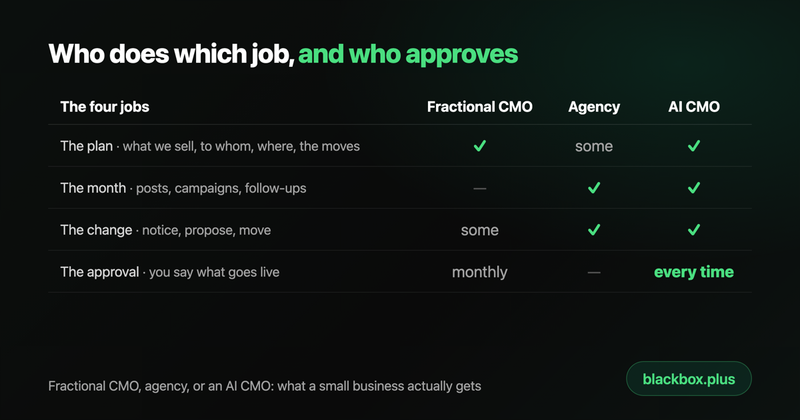
Strip the labels away and marketing leadership is four jobs. The plan: what we sell, to whom, where we show up, what we will do this quarter (the one-page version is in a marketing plan for a small business). The month: the posts, the campaigns and the follow-ups that turn the plan into days (four weeks, in order). The change: noticing that a campaign is wasting money or a post is working, and moving. The approval: someone deciding that yes, this goes live.
A fractional CMO does the plan and some of the change, and needs you to supply the month. An agency does the month and the change, and keeps the plan and the approval mostly on its side of the table. An AI CMO that proposes rather than acts does the plan, the month and the change, and gives the approval to you every single time.
That last job is the one that matters for an owner who cannot watch everything. If you are going to hand your marketing to anyone, human or software, the question to ask is not how smart they are. It is what happens before they spend your money, and whether you are in the room when it happens. For the software side of that question, sorted by the job each kind does, see AI marketing tools for a small business.
How to choose, in three questions
Do you have hands to execute? If a plan on paper would actually get done, because you have a marketer or reliable freelancers, a fractional CMO is the cheapest way to add judgment to a team that already works. If a plan on paper would sit in a folder, you need the month done too, which means an agency or an AI CMO.
Do you want to understand your own marketing, or just receive results? If you want to see the reasoning behind every change and keep the decisions, run the AI CMO yourself. If you want results and would rather not be in the loop beyond approving, have it managed, or hire an agency you trust to show you everything.
What do the next six months of budget look like? A fractional CMO is a monthly retainer. An agency is a monthly retainer plus the ad spend. An AI CMO you run yourself is a flat monthly fee plus the ad spend. None of these is wrong; the wrong one is the one your budget cannot carry for six months without flinching, because marketing that stops in month three was never a plan.
If you want to start with the AI CMO yourself, the pricing page shows both doors, and the guide to getting a marketing strategy for your small business shows what the first hour looks like. If you would rather talk to someone about running it for you, book a call from the same page.
When to move up
The three shapes are a ladder more than a choice. A business with no team and a small budget starts by running the AI CMO itself: the plan written, the calendar filled, the leads worked in one queue, every change approved by the owner. When the plan is working and the budget grows, the same business can have Blackbox run it, with the same workspace and the same approvals, so nothing is handed over blind. And when the business has a team of its own, a fractional CMO sitting on top of that workspace is the natural next hire, because they arrive to a plan, a calendar and a track record instead of a blank page.
What you should not do is start at the top. A fractional CMO hired before there is anyone to execute, or an agency retained before you can judge its report, is the most common way a small business spends a year on marketing and ends it with a document and a deck.
Frequently asked questions
Is a fractional CMO worth it for a small business?
It is worth it when you have people to execute and nobody to decide, and it is a poor fit when you have nobody to execute at all. A fractional CMO produces strategy and a monthly steer, not posts and campaigns. If the plan would sit in a folder, you need the month done as well, which is what an agency or an AI CMO is for.
What is the difference between a fractional CMO and a marketing agency?
A fractional CMO decides and delegates; an agency executes and reports. The CMO is one senior person on a retainer who sets direction and relies on your team to carry it out. The agency is a team on a retainer that does the work in its own tools and shows you the results. Neither puts you in the approval seat for every change by default.
Can an AI replace a fractional CMO?
For a small business without a marketing team, an AI CMO covers more of the job than a fractional CMO does, because it does the plan and the month, not only the plan. What it does not replace is judgment about things only you know, which is why a good one asks you those questions and waits for your approval on every change. For a business with a team, the two are complementary: the AI CMO keeps the plan, the calendar and the suggestions running, and a fractional CMO brings experience to the decisions that are not in the data.
What does a fractional CMO cost compared to an agency?
Both are monthly retainers, and an agency also runs your ad spend on top of its fee. An AI CMO you run yourself is a flat monthly fee plus your ad spend. The useful comparison is not the price tags, which vary by market and scope, but the shape: a retainer buys someone's time, a flat fee buys a system, and your ad spend is the same under all three.
How much of my time does each option take?
A fractional CMO takes a monthly call plus whatever it takes to get the plan executed by your team. An agency takes briefing and review time, usually a few hours a month, plus the time to read a report you did not write. An AI CMO takes the few answers only you have at the start and then the approvals, which is about twenty minutes a day for most businesses, because nothing goes live until you say so.