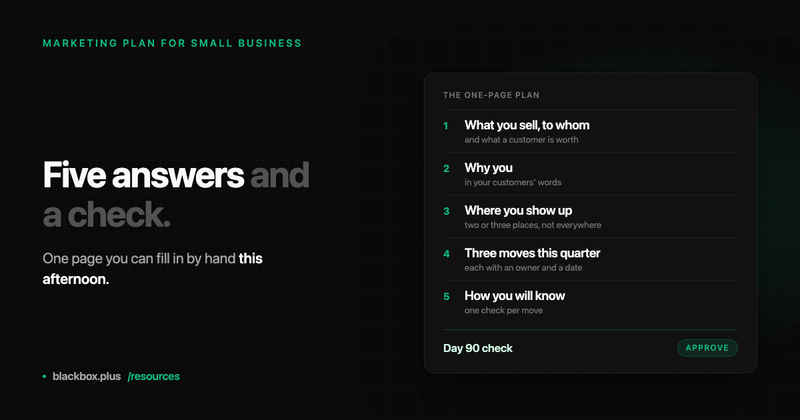
A marketing plan for a small business is five answers and a check, written on one page: what you sell and to whom, why a customer picks you, where you show up, the three moves you will make this quarter, and how you will know on day 90 whether they worked. Anything longer is a business plan wearing a marketing hat. If you run the marketing yourself, on top of another job, a plan that fits on one page is the only kind you will finish, and the only kind you will look at again in week six. Below is the page itself, a worked example, and how to turn it into a month of real work. If you would rather have it drafted for you, the AI CMO in Blackbox (blackbox.plus) writes this same page from your website and a few answers, and nothing goes live until you approve it.
What a marketing plan for a small business actually is
Search for a template and you will find twelve sections: executive summary, mission statement, market analysis, competitor matrix, a twelve-month calendar. They are written for a team with a project tool and a week to spare. An owner opens one, loses the thread at the competitor matrix and goes back to posting when there is time.
A plan that works for one person is smaller, and the edit that matters is what you leave out. It is not a business plan, so there is no executive summary. It is not a twelve-month forecast, because a small business cannot predict twelve months, and a plan that pretends to will be wrong by March. And it is not a list of tactics. A list of tactics tells you what you could do. A plan tells you which three things you will do, who does them and by when, and how you will decide whether they were worth it.
That is the whole shape: five answers, and a check chosen before you start.
The one-page plan, section by section
Copy these five headings into a blank document. Each one has the question, what a good answer looks like, and a weak answer with its fix.
1. What you sell, to whom, and what a customer is worth
Answer in three sentences, one each. What you sell. Who buys it, described as a situation rather than a type of person. And what one customer is worth to you, meaning the typical sale and how often they come back.
A good answer: "We bake custom celebration cakes for families in the neighbourhood who need one within the week. A typical order is worth more than a day's takings from the counter." A weak answer: "We sell high-quality baked goods to everyone." The fix is to name the one customer you would most like ten more of. You can widen it later.
Owners skip the worth of a customer, yet it decides how much you can spend to win one. If you do not know it, estimate it and say so.
2. Why you
The one reason a customer picks you over the next option, in their words rather than yours. Not "quality" or "service", which every competitor claims. Read your best reviews, or ask your three best customers why they chose you, and copy what they say.
A weak answer is a list of five strengths. The fix is to pick one you can put in every post.
3. Where you show up
Name the few places your customer already is, and rule out the rest. For most small businesses the candidates are: Google search and Search Console to see what people actually type, Instagram or TikTok if your customer is there and you can show your work, paid ads on Meta, Google, TikTok, Snapchat or LinkedIn if you have something to sell that justifies spend, email to the people who already bought, and the local places where your customers already look.
Pick two or three. A weak answer is "everywhere". The fix is to ask where your last ten customers found you, and start with the top two.
4. The three moves this quarter
Exactly three, each with an owner and a date. A move is a thing you can finish or start, not an aspiration: "Publish two posts a week showing finished cakes, starting the first Monday of the month." "Set up the Google Business listing with current hours and photos by the fifteenth." "Call every enquiry within a day."
A weak answer is eight moves, which means none of them gets done. The fix is a ranking: which three, if done well, would matter most to the customer in answer one? The rest goes on a "later" list that you are allowed to ignore.
5. How you will know by day 90
One check per move, chosen before you start. Not "see if it works", but something you can read off a page: the number of enquiries that mention the new post, the number of calls that came from the listing, whether every enquiry was answered within a day. Decide today what "worked" looks like, because after ninety days it is easy to decide that whatever happened was what you meant.
Put the date in your calendar now. That date is the plan's only real deadline.
A worked example
This is an invented business, used only to show the page filled in. It is not a real customer and carries no results.
A neighbourhood bakery that makes celebration cakes and sells bread at the counter.
- What, to whom, worth. Custom celebration cakes for local families who need one within a week. A typical order is worth more than a day at the counter, and some customers come back each year for the same occasion. (An estimate, to be checked against the till.)
- Why us. In the words of the bakery's own reviews: "she made exactly what my daughter drew."
- Where we show up. Instagram, because the product is visual, and Google, because people search for a cake near them. Nothing else this quarter.
- Move one. Two posts a week showing finished cakes, each tagged with the occasion. Owner: the baker. Starts the first Monday.
- Move two. A Google Business listing with current hours, photos and an ordering link. Owner: the shop assistant. Done by the fifteenth.
- Move three. Every enquiry answered within a day, with a quote. Owner: the baker. Starts now.
- Day 90. Enquiries per week against the last three months. Calls and direction requests from the listing. The share of enquiries answered within a day, which should be all of them.
That is the whole plan, and on day 90 nobody will need to argue about whether it worked.
If you would rather not write this page by hand, have your plan drafted and approve it, or talk to us about running it for you.
From plan to month
A plan on one page is only worth something if the month gets filled. Turn each move into dated work on a calendar, and keep the calendar to what you can actually do. Two or three posts a week is a fine plan for someone with a day job. Eight is a plan for a team.
Then review on a rhythm: a short look at day 30, another at day 60, and the real check at day 90. At each, change one thing, not five. If you change everything, you will not know which change mattered.
The guide to planning a content calendar walks through turning moves into dated posts, and the fractional CMO, agency or AI CMO comparison covers who can carry the plan if you cannot.
Having the plan drafted for you
The AI CMO in Blackbox does this job. It reads your website and the accounts you connect, then drafts the same one-page strategy for each brand and each market you sell in: what you sell and to whom, why you, where you show up, the three moves this quarter, and how you will know by day 90. It asks you the few things it cannot know, such as what a sale is worth.
Then it fills the month on one calendar. Posts are drafted from your own site. Campaigns are written from a short brief and created paused. Dated suggestions arrive with their reasoning and a four-week estimate, and follow-ups on leads land on the same calendar. Nothing goes live until you approve it. The plan downloads as a pitch deck or as a full strategy, and the features page shows each part as it looks in the product. The guide to approving your strategy shows the first hour.
There are two doors. Do it yourself, on a flat monthly plan, or have Blackbox run it with you in the same workspace. The pricing page shows both, and you can schedule a call from there.
Have your plan drafted if you want to run it yourself, or talk to us about running it for you.
Frequently asked questions
How long should a marketing plan for a small business be?
One page. It should hold five answers in order: what you sell, to whom and what a customer is worth; why a customer picks you; where you show up; the three moves you will make this quarter; and how you will know by day 90.
How do I write a marketing plan with no budget?
Write the same five answers and choose moves that cost time rather than money. Free places to show up include Google search, Instagram and TikTok organic posts, a complete Google Business listing and email to people who already bought. Spend on ads only once you know what a customer is worth, because that number tells you what you can afford to pay to win one.
How often should I update my marketing plan?
Review it at day 30, day 60 and day 90, and write a new one each quarter. At each review, change one thing and keep the rest, so you can tell what made the difference. Rewrite the whole page only when something fundamental changes, such as a new product or market.
Can AI write a marketing plan for me?
Yes, for the parts that come from your business and your accounts. An AI CMO such as Blackbox reads your website and connected accounts, drafts the one-page plan and asks you what only you know, such as what a sale is worth. It cannot decide what you are willing to promise or do, so a good one waits for your approval before anything goes live.
What is the difference between a marketing plan and a marketing strategy?
A strategy is the reasoning: who you sell to, why they choose you and where you can win. A plan is that reasoning turned into dated work: the three moves, who does them and how you will check. On one page, answers one to three are the strategy and answers four and five are the plan.