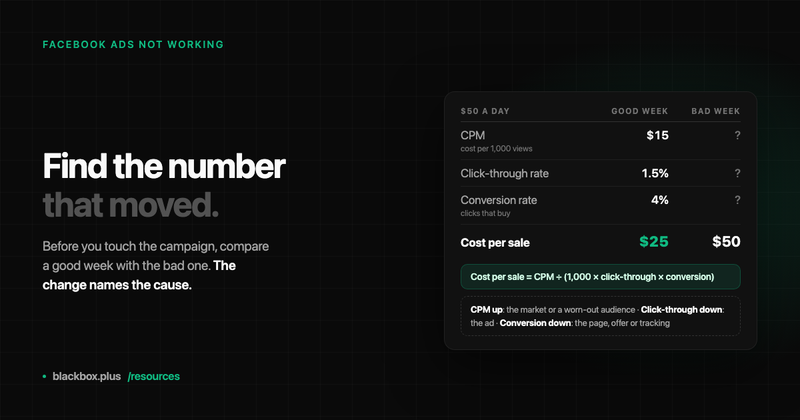
When Facebook ads that used to sell stop working, don't change anything until you know which number moved. Check that the drop is real over a full week, check that Meta's count matches your actual sales, then compare three numbers against a good week: cost per 1,000 views (CPM), click-through rate and conversion rate. The one that moved tells you what broke, and whether to fix the ad, the page, the offer or nothing at all.
Most "dead" campaigns turn out to be a normal bad day, a tracking gap or a seasonal rise in costs. Those need patience, not a rebuild.
The short version:
- Judge the last 7 days against the 7 before, never a single day.
- Compare Meta's purchases or leads with your store orders or inbox for the same dates.
- Cost per sale = CPM ÷ (1,000 × click-through rate × conversion rate); find which part changed.
- Every edit can restart Meta's learning, so make one change at a time and wait a week.
- Stop a campaign only when its cost per sale stays above what a sale leaves you for two weeks after the fixes.
Why did my Facebook ads stop working?
Facebook ads usually stop working for one of five reasons: a normal swing that looks like a drop, tracking that stopped counting, costs rising across the market, an ad people are tired of, or a change to the page, offer or campaign. Each one shows up in a different number, so you can tell them apart before you touch anything.
Here is the example this page uses. A small online store sells a $60 order that leaves $30 after product, shipping and fees. That $30 is the most it can pay in ads per sale. It spends $50 a day.
In a good month it paid $25 a sale, 2 sales a day. This month it's 1 sale a day at $50, well over the $30 it can afford.
Is it a real drop or just a bad day?
Look at the last 7 days against the 7 before, and ignore single days. Small accounts swing a lot by chance.
At an average of 2 sales a day, a day with no sales comes about once a week even when nothing has changed. It means nothing on its own.
So don't pause, cut the budget or swap ads after one or two bad days. Changes made off a bad day often turn it into a bad week, because Meta has to re-learn after them.
Do Meta's numbers match your actual sales?
Before blaming the ads, put Meta's purchases (or leads) for the last 14 days next to your store's orders, inbox or call log for the same dates. Look for three things:
- Purchases that only Meta sees. If Meta reports more sales than came in, the attribution setting may be counting people who saw an ad and bought anyway. The default counts sales within 7 days of a click or 1 day of a view.
- Sales Meta stopped seeing. If your orders held up but Meta's count fell, the pixel or the conversions setup has broken, often after a site, theme or checkout update.
- Clicks that never arrive. Compare Meta's link clicks with the visits your store recorded from Facebook. A big gap usually means the page loads slowly in the Facebook app. Open your ad on your phone from the app and time it.
Fix the tracking first; every other check depends on it.
Which number moved: CPM, click-through rate or conversion rate?
Cost per sale is made of three numbers: what Meta charges to show your ad 1,000 times (CPM), the share of people who click (click-through rate), and the share of clicks that buy (conversion rate). Write them down for a good week and for the bad week. The one that changed points at the cause.
For the example store's good month: $15 CPM and 1.5% click-through is $1 a click, so $50 buys 50 clicks; 4% of those buy, which is 2 sales at $25 each.
Now three ways to end up at 1 sale a day and $50 a sale:
- CPM doubled to $30, click-through and conversion the same. Clicks cost $2, so $50 buys 25 clicks and 1 sale. That's the market getting dearer (common in November and December) or Meta running out of the cheapest people to reach. The ads and the page are fine.
- Click-through halved to 0.75%, CPM the same. Again $2 a click and 1 sale. People are scrolling past the ad: fatigue, or an ad that has stopped matching what they want.
- Clicks held at 50, but only 2% buy. The ad still works; something after the click doesn't. Check the price, stock, shipping cost, a discount that ended, page speed and the checkout.
A new ad won't fix a broken checkout, and a new page won't bring CPM down.
Why do my Facebook ads work for a few days and then die?
Usually because something reset or used up what made the first days good. Check these, in order:
- You edited the campaign. Budget changes, new ads, new targeting or a long pause can send an ad set back into Meta's learning phase. Meta wants about 50 results in a week to settle, which a small budget may never reach.
- A new campaign is competing with the old one. Launch a second campaign for the same buyers, and the two can bid against each other. If the old one dropped when the new one started, put the new ads into the old campaign instead.
- The warm people ran out. The first days reach your past visitors, followers and people like them, who buy easily. After that, Meta is finding strangers, who cost more per sale.
- The first days were counted generously. Very cheap early sales that your store never saw are often view-through sales, and that pool dries up fast.
Also, Meta can spend up to 75% over the daily budget on one day and less on another, keeping the week near 7 times the daily budget. A big day then a quiet one is often just that.
Is it ad fatigue?
It's ad fatigue when the same ad's click-through rate falls week after week while its frequency (how many times each person has seen it) keeps rising. A 7-day frequency above about 3, with click-through down by a third or more from the ad's first weeks, is the usual sign.
The fix is a new ad, not the same ad in a new colour: change the opening line, the first second of the video or the problem it names. Add it to the ad set that works rather than a new campaign.
Why are my Facebook ads costing more in Q4?
Because more advertisers bid for the same people from November to Christmas. CPMs usually climb through November, peak around Black Friday and Cyber Monday, stay high until the last shipping days, then fall in January.
Decide on cost per sale, not CPM: shoppers are readier to buy in this stretch, which offsets part of the rise. If cost per sale is still under what a sale leaves you, keep running. If it's over, pause the campaigns aimed at new people, keep a small budget on past visitors and customers, and bring the rest back after Christmas. For working out what a sale leaves you, see how to work out break-even ROAS.
Should I turn off my Facebook ads?
Not after a bad day or a bad week. Turn a campaign off when its cost per sale has stayed above what a sale leaves you for two weeks, after you've fixed the tracking and the cause you found above.
Until then, make one change at a time and give it a week, or you won't know which one helped. A change also has to beat leaving things alone: under break-even, the safest move is often none.
When it recovers, raise the budget 20–30% at a time, a few days apart; a jump from $50 to $200 a day is close to a new campaign. On judging new ads with little spend, see Facebook ads on a small budget.
What if my Facebook ads aren't spending at all?
Then it's a delivery problem. Check the status in Ads Manager: the usual reasons are an ad in review or rejected, a failed payment, a restricted account, an audience too small, or a cost cap below what results cost.
How Blackbox reads a drop
Blackbox (blackbox.plus) is an AI CMO for small businesses that run their own marketing. On the Campaigns tab in Plan, each campaign gets a plain verdict, and its Results page shows cost per result against your break-even and where people drop off from ad to result, next to the usual rate for your industry (how to tell if your Facebook ads are working). If Meta won't run an ad, its reason shows there too. Budget and pause suggestions only show up when their forecast beats leaving the campaign alone (acting on suggestions), and you can ask Blake for a weekly review of your ads so a drop is caught on a full week, not a bad day. To check what Meta counts as a result, see bidding and tracking on Meta.
FAQ
Why did my Facebook ads stop working all of a sudden?
Most sudden drops are a normal bad day, a tracking gap, or an edit that restarted Meta's learning. Compare the last 7 days with the 7 before, and Meta's sales with your own orders.
My Meta ads were working and now they're not, what should I check first?
Check whether Meta's purchases or leads match your store orders or inbox for the same dates. Then split cost per sale into CPM, click-through rate and conversion rate, and see which one moved.
Why do my Facebook ads work for 2 days and then die?
Usually an edit or a new campaign reset the learning phase, the first days used up your warmest audience, or early sales were view-through sales that dry up. Meta wants about 50 results a week per ad set to settle, which small budgets often can't reach.
How many days should I wait before changing a Facebook campaign?
Wait for a full 7 days and compare them with the 7 before. After a change, give it another week before the next one, so you can tell what worked.
Should I turn off Facebook ads when sales drop?
Only when cost per sale has stayed above what a sale leaves you for two weeks, after fixing tracking and the cause you found. If the campaign is still under break-even, leaving it alone usually beats changing it.