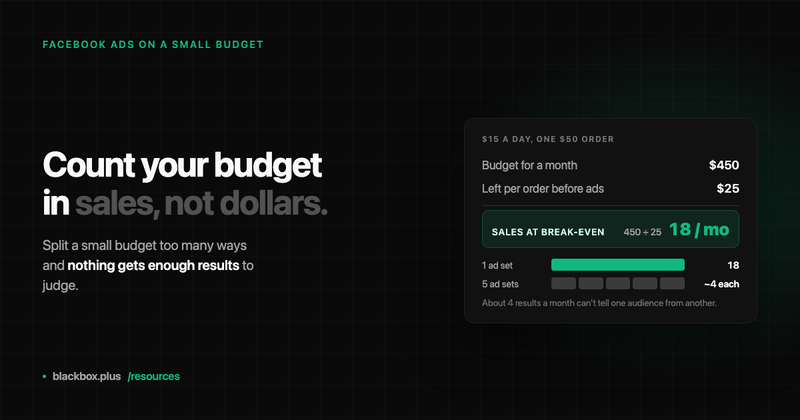
Facebook ads on a small budget can work, as long as you treat the budget as a number of results, not a number of dollars. Divide a month's budget by the most you can pay for one sale or lead, and you know how many you can buy. At $15 a day, a store whose $50 order leaves $25 before ads can afford about 18 sales a month at break-even.
That number decides everything else. Eighteen results a month can feed one ad set with a few ads. Split across five ad sets, each one gets three or four, and none of them tells you anything.
The short version:
- Work out what your budget buys: monthly budget ÷ the most you can pay per sale or lead.
- Run one campaign with one ad set, the Sales or Leads objective, broad targeting and 2–4 ads.
- Let the ad do the targeting; narrow only on things that truly rule people out, like location.
- Judge on a full week, and turn an ad off once it has spent twice your break-even cost with no result.
- Raise the budget only after the cost per result has held under break-even for a week.
Is $10–20 a day enough for Facebook ads?
Yes, for one clear goal, but not for testing lots of things at once. A small budget can find out whether one offer sells at a price you can afford. It can't compare five audiences and ten creatives, because each of them needs results of its own to judge.
Turn the budget into results before you decide anything:
- Multiply the daily budget by 30. $15 a day is $450 a month.
- Work out the most you can pay for one sale: what an order leaves you after product, shipping and fees, before ads. Our break-even ROAS guide walks through it. In the example, a $50 order leaves $25.
- Divide. $450 ÷ $25 = 18 sales a month at break-even, about 4 a week.
Lead businesses work the same way. If a customer is worth $300 to you and 1 in 10 leads becomes a customer, a lead is worth $30. At $10 a day, $300 a month buys about 10 leads at break-even.
If that number comes out at one or two a month, the budget is too small for the price you can pay. Raise the budget, raise what each sale leaves you, or pick a cheaper result to aim for first.
How much should you spend on Facebook ads per day?
Spend enough to get at least a few results a week at your break-even cost per sale, so you can read results weekly. For the example store, $15 a day buys about 4 sales a week, which is the lower end of readable.
There's no single right number. Meta accepts budgets of a dollar or two a day, and many ranking pages suggest $15–20. Neither is useful on its own: $15 a day is plenty for a $10 product that leaves $5, and far too little for a $2,000 service where a lead can cost $150.
The figure that matters is what a result costs you. Start where you can afford a few a week, then let the results decide the next step.
How should you set up Facebook ads on a small budget?
Run one campaign, with one ad set and 2–4 ads, aimed at the result you actually want. Keeping everything in one place lets each result teach Meta's delivery something, instead of spreading a few results across many pieces.
- Objective: Sales if you sell online and your tracking records purchases; Leads if people fill a form or message you. Not Traffic or Engagement: those find people who click and like, not people who buy.
- One ad set: one budget, one audience. Use a campaign budget only once you have more than one ad set worth keeping.
- Audience: broad. Your country or service area, an age range only if it really rules people out, no stacked interests.
- Placements: leave Advantage+ placements on unless one placement clearly doesn't fit your product.
- Ads: 2–4, each a genuinely different idea, not the same image in three colours.
Our guides show how to create a Facebook ad campaign and how to set up ad sets in one campaign once you're ready for a second one.
Should you narrow your audience or go broad on a small budget?
Go broad, and let the ad do the targeting. Every interest or income layer you stack makes the audience smaller and each impression dearer, and on a small budget you can't afford the extra cost per result.
The ad is a better filter than the settings. A headline that says who it's for and a picture of the product in use attract the right people and put off the rest. "Online maths tutoring for ages 8–12, evenings in your time zone" targets better than three interest layers.
Narrow only on things that genuinely rule people out:
- where you can deliver or serve,
- the language your business works in,
- a legal age limit for what you sell.
Test audiences later, once you can afford about 20 results per audience.
How many ads should you run with a small budget?
Two to four. Meta doesn't spread a budget evenly across ads: it moves most of the spend to the one or two it predicts will do best. Launch ten ads on $15 a day and most of them get a few dollars each, too little to judge.
Pick the strongest ideas first. A short video of the product in use, a clear photo with the price, and a customer's own words cover three different angles. Keep the rest of your photos for when one of these wears out.
Don't add a new ad every couple of days. Each new ad pulls budget from the ones that are working, before anything has had time to prove itself.
How long should you run Facebook ads before judging them?
Give a new campaign a full week before you judge it, and judge on the week's total, not on any single day. At 4 sales a week, a day with none and a day with two both happen by chance.
Two rules make the call less of a feeling:
- Turn an ad off once it has spent twice your break-even cost with no result. In the example, that's $50 with no sale.
- Judge the campaign on cost per result for the week. Under $25 per sale: keep it running. Over: change one thing, then give that change its own week.
You will probably see "Learning limited" in Ads Manager. Meta wants around 50 results a week per ad set to finish learning; at a $25 cost per sale, that's about $1,250 a week. On a small budget it's a label, not a failure. Judge the results against your break-even, not the delivery status.
If a campaign that was selling suddenly stops, see what to check when Facebook ads stop working before you change anything. Our guide to reading an ad set test shows the same check done for you at the end of a test window.
Why is my CPM so high on a new ad account?
New accounts, new pages and new pixels often pay more per thousand impressions in their first days, while Meta has no history to go on. A CPM far above what others in your market pay usually has a cause you can check.
Before you blame the account, look at:
- Placements and countries. Open the breakdown in Ads Manager. Feed-only placements, or one expensive country, can drive the average up on their own.
- Quality ranking. Ad-level diagnostics show whether Meta rates the ad below average. A low ranking raises what you pay per impression.
- The optimisation event. Optimising for purchases on a pixel that has never recorded one gives delivery nothing to work with. Check the pixel fires on a real test order.
- Account Quality. A past restriction on the business portfolio can affect every ad account in it.
A new ad account in the same business portfolio rarely fixes high costs, and opening several in a row can itself look risky to Meta. Fix the cause first.
When should you raise your Facebook ads budget?
Raise it once the cost per result has stayed under your break-even for at least a full week, and raise it in steps of about 20% every few days. Big jumps tend to push the cost per result up while delivery adjusts.
If the cost per result is above break-even, a bigger budget makes the loss bigger, not smaller. Fix the offer, the ad or the tracking first. Our break-even ROAS guide lists what to check, in order.
Every change, a new budget included, has to beat leaving things as they are. If you can't say what result would prove it worked, and over what window, wait.
How Blackbox runs a small budget
Blackbox (blackbox.plus) is an AI CMO for small businesses that run their own marketing. Blackbox works out the most you can pay per result from your prices when it builds your strategy, then starts a campaign as one ad set with a few ads, so a small budget isn't split. Its budget and pause suggestions have to beat doing nothing, judged over one window, before they reach you.
FAQ
Is $10 a day enough for Facebook ads?
It's enough to test one offer, if your break-even cost per sale is low enough. Divide $300 a month by the most you can pay for one sale or lead: if that gives you at least a few results a week, $10 a day can tell you whether the offer sells. If it gives one or two a month, it can't.
Should I narrow my Meta ads audience with a small budget?
Usually not. Stacked interests make each impression more expensive, and a small budget can't afford that. Target broadly by location and let the ad's words and picture attract the right people; narrow only on things that truly rule people out.
How many ads should I run with a $15 a day budget?
Two to four, in one ad set. Meta sends most of the budget to the ads it expects to do best, so more ads mostly means more ads that barely spend. Keep spare creative for when one of the first ads wears out.
How long should I run Facebook ads before judging them?
At least a full week, judged on the week's cost per result rather than any single day. Turn off an individual ad once it has spent about twice your break-even cost per sale with no result.
Should I start a new ad account if my CPM is high?
Rarely. Check placements, countries, the ad's quality ranking, whether your pixel records the event you optimise for, and Account Quality first. A new ad account in the same business portfolio usually inherits the same problem.