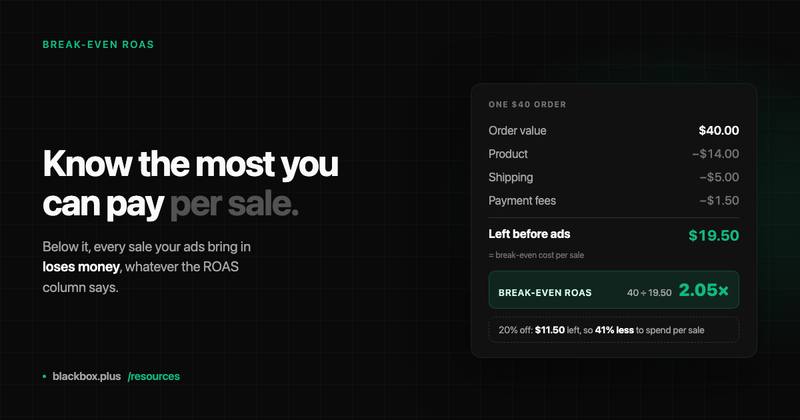
Break-even ROAS is the return on ad spend at which your ads pay for themselves and nothing more. Work it out as your average order value divided by what an order leaves you after product, shipping and fees, before ads. A $40 order that leaves you $19.50 has a break-even ROAS of 2.05: every $1 of ads has to bring back $2.05 in sales just to stand still.
The same number in money is your break-even cost per sale: $19.50 here. Pay more than that in ads for a sale and you lose money on it, however good the ROAS column looks. (Selling a service that takes leads instead? The same idea gives you a break-even cost per lead.)
The short version:
- Break-even ROAS = order value ÷ what the order leaves you before ads.
- What the order leaves you is also the most you can pay in ads for one sale.
- A 20% discount cuts that amount by far more than 20%: by 41% in the example below.
- Repeat buyers let you pay more for the first sale, but only if your own order history shows they come back.
- Below break-even, fix tracking and what each order leaves you before you touch the ads.
Break-even ROAS calculator
Your average order, and what one order costs you to deliver before ads: product, shipping and payment fees.
- Break-even ROAS
- 2.05
- Most you can pay per sale
- $19.50
- ROAS to keep 10% profit
- 2.58
Every $1 of ads has to bring back $2.05 in sales to stand still. Below that, each sale loses money.
What is break-even ROAS?
ROAS, return on ad spend, is the sales your ads brought in divided by what you spent on them. Spend $100, get $300 in sales, and your ROAS is 3.
Break-even ROAS is the ROAS where the money left from those sales exactly covers the ads. Below it, every sale costs you money. Above it, every sale adds profit.
The formula has two equivalent forms:
- Break-even ROAS = average order value ÷ what an order leaves you before ads
- Break-even ROAS = 1 ÷ your margin before ads (as a decimal)
Take a store whose average order is $40. The products in it cost $14, shipping costs $5, and payment fees are about $1.50. That leaves $19.50 per order, a 48.75% margin before ads. The break-even ROAS is 40 ÷ 19.50, or 1 ÷ 0.4875, which is 2.05.
Break-even cost per sale: the same number in money
ROAS is a ratio, and ratios are easy to misread on a small budget. The money version is clearer: your break-even cost per sale, sometimes called break-even CPA, is simply what an order leaves you before ads. In the example, that's $19.50.
This is the number to keep next to your ads manager. If Meta or Google reports a cost per purchase of $24, you don't need to convert anything: each of those sales lost about $4.50.
How do you calculate break-even ROAS?
Use what a typical order really costs you, not the product's sticker margin.
- Take your average order value over the last month or two, after any discounts you normally give.
- Subtract the product cost for an average order (what you paid for the goods, or what it costs you to make them).
- Subtract what it costs to get it to the customer: shipping, packaging, pick-and-pack fees.
- Subtract payment processing and any marketplace or platform fee charged per order.
- Subtract returns and refunds. If about 1 in 20 orders comes back, take 5% of the order value off.
- What's left is your break-even cost per sale. Divide the order value by it for your break-even ROAS.
Leave out fixed costs such as rent, software subscriptions and your own time. They don't change with one more sale, so folding them in makes every campaign look like a loss.
Fixed costs decide whether the business makes money overall. They're the wrong test for whether one more ad dollar pays.
Selling a service? Work per customer instead of per order. What a customer pays you, minus what it costs to deliver the work, is the most you can pay to win them.
For lead-based businesses, multiply that by the share of leads that become customers. That's the most you can pay per lead. If your Google Ads leads cost more than that, or barely come in, here's what to check when Google Ads isn't working.
Will a 20% off sale still make money? How discounts change break-even ROAS
Often not. A 20% discount cuts what you can afford to pay for a sale by far more than 20%, and this is where small stores lose the most money without noticing, especially around Black Friday.
A percentage discount comes straight out of what each order leaves you, while the product, shipping and fees stay the same. Put 20% off the $40 order from earlier:
- The order is now $32.
- Product, shipping and fees are still about $20.50.
- What's left drops from $19.50 to $11.50.
- Break-even ROAS rises from 2.05 to 2.78.
- Break-even cost per sale falls from $19.50 to $11.50, a 41% cut.
So 20% off didn't cut what you can afford to pay for a sale by 20%. It cut it by 41%. If your ads were getting sales at $15 each before the sale, they were profitable. At the same cost during the sale, every order loses $3.50.
Sales do raise conversion rates, so the cost per sale often falls during a promotion. The question to ask before you launch is whether it will fall far enough: in this example, from $15 to under $11.50.
A fixed offer usually holds up better than a percentage. Free shipping over a set order value costs you the same few dollars whether the order is $45 or $80, and it nudges people to add a second item. A free gift with orders over a threshold works the same way. Both protect what each order leaves you; 20% off everything shrinks it on every order.
Can ads work if customers only buy once?
Yes, as long as one order leaves you more than a sale costs in ads. The formula above assumes exactly that: one order per customer. If people do come back, the first sale is worth paying more for.
Say a quarter of your buyers order once more within six months, at the same $19.50 each. One customer is then worth $19.50 × 1.25, about $24.40, so you could pay up to about $24 for the first sale and still break even within six months.
Two cautions. Use repeat rates from your own order history, not a hope; a new store has no data here yet and should judge on the first order. And pick a period you can afford to wait for, because the money for the ad leaves today and the repeat order arrives months later.
If people genuinely buy once and never return, and your break-even cost per sale is small, the fix is usually the offer, not the ads: bundles, a higher price, or a product people buy again.
What is a good ROAS?
A good ROAS is one above your break-even, and how far above depends on what profit you want from ad-driven sales. There's no universal good number: a 2x ROAS is break-even for a 50% margin, comfortable profit for a 70% margin, and a loss at 30%.
To set a target ROAS for a profit, subtract the profit you want (as a share of sales) from your margin before ads, then divide 1 by the result. For the example store, aiming to keep 10% of every sale as profit after ads:
- 0.4875 − 0.10 = 0.3875
- 1 ÷ 0.3875 = a target ROAS of about 2.58
Treat break-even as survival and the target as the goal. On Google, judge a Performance Max campaign's return with sales from your own brand searches taken out; see is Performance Max worth it. When you scale a campaign, its ROAS usually drops a little, so start from a target with room above break-even.
Getting sales but losing money on ads? What to fix first
Fix the numbers before the ads: check the sales are real, judge on a full week, and raise what each order leaves you before you change the campaign. Work through these in order; the early steps are cheap and often change the picture.
- Check the sales are real. Compare the purchases your ads manager reports with the orders in your store for the same days. If they disagree badly, you're judging on the wrong numbers. Fix tracking before anything else.
- Judge on a week, not a day. At two or three sales a day, a zero day and a great day both happen by chance. Compare the last 7 days with the 7 before. Don't change budgets because of one morning, and don't make the next change until the last one has had a week to show. On a small budget, work out how many sales it can buy before you judge it.
- Raise what each order leaves you. Bundles, a free-shipping threshold above your average order, a price rise on your best seller, cheaper shipping. Lifting what an order leaves you from $19.50 to $25 makes the same ads profitable, without touching the campaign.
- Optimize for purchases. If the campaign is set to optimize for clicks, landing page views or add-to-carts, the platform finds people who click, not people who buy. Set the conversion goal to purchases once you have the tracking for it.
- Then work on the ads. New creative, a clearer offer in the first line, a different audience. Run tests in their own campaign or ad set, so a bad test can't eat the budget of what already works.
- Know when to stop. If the cost per sale stays above break-even for a full buying cycle after all of the above, the channel isn't working at this price. Move the budget, or change the offer and try again.
One rule runs through all six: a change has to beat leaving things as they are. If you can't say what result would prove a change worked, and over what window, wait.
How Blackbox uses your break-even
Blackbox (blackbox.plus) is an AI CMO for small businesses that run their own marketing. When Blackbox builds your marketing strategy, it asks for your prices and budget, and what a customer is worth to you; answering those questions takes about five minutes. Every budget or pause suggestion it then makes has to beat doing nothing, judged over one window, before it reaches you; see how optimization suggestions work. For a wider view of what your ads are doing for the business, see how to measure marketing effectiveness, and for where ads fit in a whole plan, the small business marketing plan.
FAQ
What is break-even ROAS and how do I calculate it?
Break-even ROAS is the return on ad spend at which ad-driven sales exactly cover the ad cost. Calculate it as your average order value divided by what an order leaves you after product, shipping, fees and returns. A $40 order that leaves $19.50 has a break-even ROAS of 2.05.
Is a 2x ROAS good?
It depends on your margin. A 2x ROAS is break-even at a 50% margin before ads, profitable above that, and a loss below it. Work out your own break-even ROAS first; any ROAS above it is making money.
Why am I getting sales from Facebook ads but losing money?
Usually because each sale costs more in ads than the order leaves you after product, shipping and fees. Compare your cost per purchase with your break-even cost per sale. If it's higher, every sale loses money, and you need either cheaper sales or orders that leave you more.
Should I run a 20% off sale if my ads are barely profitable?
Probably not as a percentage discount. On a store with about a 49% margin before ads, 20% off cuts what you can afford to pay per sale by about 41%, so barely profitable ads turn into a loss unless the cost per sale falls a lot. A fixed offer, such as free shipping over an order value, usually costs less per order.
What is the difference between ROAS and break-even ROAS?
ROAS is what your ads actually returned: sales divided by ad spend. Break-even ROAS is the minimum they need to return so you don't lose money. Comparing the two tells you whether your ads are making or losing money.