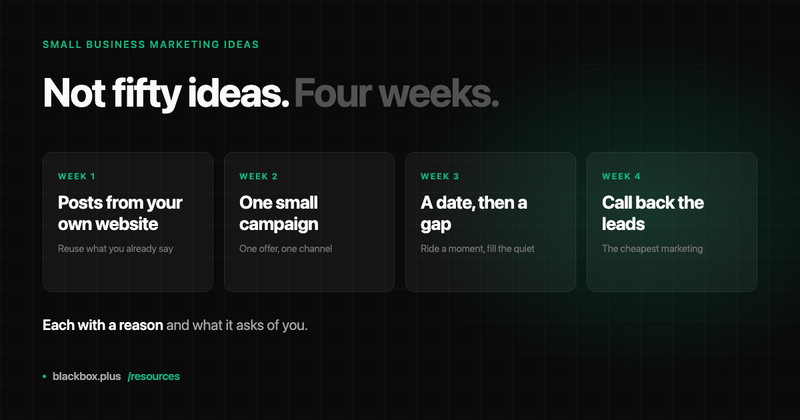
There is no shortage of small business marketing ideas. The useful question is which four to do this month and in which order, because the same idea works or flops depending on the week it lands in. Post about what you sell first, point a small campaign at it second, ride a date third, and call back the people who already asked fourth. That is the whole month, and the rest of this page is the reason each one sits where it does. Blackbox (blackbox.plus) is an AI CMO that fills a calendar this way, so we will say where it drafts the work for you. But the order stands on its own, and you can follow it with a notebook.
Why a list of fifty small business marketing ideas does not help
Search for ideas and you get lists whose length is the selling point: seven, eighteen, twenty-seven, forty-five, a hundred and one. They are sorted by cost, or by theme, and none is sorted by time. Nothing says what to do in the first week and what to leave until the third, and nothing admits that a list of fifty is itself the problem for a person with one evening a week.
The owner reading it does not lack ideas. They have bookmarked three and done none. What they lack is a Tuesday: a specific thing, on a specific day, that someone has already decided belongs there. The unit that gets done is not an idea. It is a calendar entry.
So each idea below gets three things. A week, because order is the part the lists leave out. A reason, so you can disagree with it. And what it asks of you, because a plan that hides the work is the reason lists go unread.
Before week one: five minutes that make the month cheaper
Write down three things. What you sell. Who buys it. And the one thing that makes someone choose you over the other option on the same street or the same search page. A paragraph is enough. If you want the longer version, the guide to getting a marketing strategy for your small business walks through a one-page plan.
Then name the markets you sell in. A holiday, a season and a school term differ by country and sometimes by city, and week three depends on them. This is also what an AI CMO asks you first: the few things it cannot know from your website, such as what a sale is worth and where your customers are.
Week 1: put your own words on the calendar
Plan three or four posts, drawn from what your business already says. What you sell and who it is for. A question a customer asks every week, answered. The work behind the product, the part people never see. One post about why you do it this way.
The reason this comes first is that your website already holds the best material you have. Week one reuses it before you invent anything, and it gives weeks two and three something worth pointing people at. A campaign that sends strangers to a thin page spends money on the thin page.
It asks three things of you. Read each draft. Change the wording where it sounds wrong, because you know how you talk. Approve it, or drop it. That is perhaps an hour.
In Blackbox this is Plan, the calendar with one calendar per brand: the AI CMO drafts the posts from your own website and puts them on the dates. The guide to planning a content calendar shows the steps. If you do it by hand, the same four post topics in a shared document work fine.
Week 2: one small campaign, run on purpose
Run one ad campaign. One offer, one audience, one channel, a small daily budget. The channel is whichever of Meta, Google, TikTok, Snapchat or LinkedIn your customers already use. Pick one. Not two, and not all five.
The reason it is second is that week one gave you something worth pointing people at. Before then you had a campaign looking for a destination. Now a few people can land on a page that sounds like you, and a post that explains what you do.
It asks you for two decisions, and only you can make them: what the offer is, and how much you will spend per day. Everything else, the audience, the wording and the setup, can be drafted from a short brief.
In Blackbox the campaign is written from that brief and created paused. Nothing runs, and nothing spends, until you approve it. If you set it up by hand in the ad platform, keep the same discipline: build it, read it twice, and switch it on on purpose.
Week 3: ride a date, then fill a gap
Pick one moment that matters to your customers. A holiday in a market you sell in, the start of a season, a local event. Plan one or two posts around it, and if it fits, a small offer. Then look at your calendar and find the gap: the stretch of days where you have gone quiet. Fill it with something small.
The reason is that a dated moment gives a post a reason to exist and a customer a reason to care now. The gap is where small businesses usually disappear. A week of silence after a busy one is how a feed that was working goes cold.
It asks you for a yes or a no. You do not need to find the moment yourself. In Blackbox the AI CMO puts dated suggestions on the calendar, each with its reasoning, such as a holiday in one of your markets or an empty week, and a four-week estimate against doing nothing. You approve it, change it, snooze it or dismiss it. If you work by hand, a paper calendar with your markets' main dates marked will do the same job.
Week 4: call back the people who already asked
Follow up on every lead your forms and ads brought in. Ask last month's customers for a review or a referral. Then look back across the month and pick the post or campaign worth repeating.
The reason it comes last is that the cheapest marketing in the month is the person who already raised a hand, and most small businesses leave them waiting. Weeks one to three bring attention. Week four is where attention becomes a conversation. Done earlier, there would be nobody to call.
It asks you to make the calls and write down what each person said. That part is yours. Nothing replaces the owner on the phone.
What software can take is the keeping track. Blackbox gathers the leads from your connected Meta and LinkedIn forms into one queue, sorted by what needs doing today, and puts follow-ups on the same calendar. The guide to managing leads from your ads shows the queue. Reviews and referrals are yours to ask for; no tool does that for you, and none should.
What to leave out of your first month
Leave out anything that needs a channel you are not already on, a new tool you have to learn, or a daily habit you cannot keep. The temptations are always the same: a new platform because someone said it is where people are, a big ad budget because the small one feels slow, a rebrand because the old look feels tired.
All of them are real ideas, and none belongs in a first month. Four things done beat fifteen started. A month with four finished entries teaches you what your customers respond to. A month with fifteen half-built ones teaches you only that you are busy.
Having the month drafted for you
If you would rather not write the month yourself, that is what an AI CMO is for. Blackbox reads your website and the accounts you connect, drafts a one-page strategy, asks the few things it cannot know, and fills the month on one calendar. Posts are drafted from your own site and scheduled. Campaigns are written from a short brief and created paused. Dated suggestions arrive with their reasoning. Follow-ups sit beside the leads your forms bring in. Nothing goes live until you approve, change, snooze or dismiss it.
There are two doors. Do it yourself, on a flat monthly plan, covers the owner with twenty minutes a day. Managed by Blackbox covers the owner who would rather receive the month than approve each part: our team runs the same AI CMO for you, in the same workspace, and you still approve. See what the Plan section does, then have your month drafted, or have Blackbox run it for you by booking a call from the same page.
It is not the right answer for everyone. If you want a person to think with, or you have a team and need a senior steer, an agency or a fractional CMO may fit better. The comparison of a fractional CMO, an agency and an AI CMO says who each one suits.
Frequently asked questions
What are the best marketing ideas for a small business?
The best ideas are the ones you will finish this month. For most small businesses that means four: posts drawn from your own website, one small campaign on a single channel, one dated moment that matters to your customers, and a call back to everyone who already asked. The order matters more than the choice, because each one sets up the next.
How do I market my small business with no budget?
Start with the parts that cost time, not money. Posts from your own website, a calendar of the dates your customers care about, and follow-ups on every lead are free to do. Ads are week two for a reason: they are the only idea here that needs a budget, and they work better once you have something worth sending people to. Skip them for a month if you must.
How often should a small business post on social media?
Post as often as you can keep up for a whole month, then adjust. Three or four posts in the first week is a sound start, because your website already holds the material. A steady rhythm you can hold beats a burst you cannot, and an empty week is the thing to avoid, not a quiet one. If you are on Instagram and TikTok, plan for each platform separately, because the same post often needs different wording.
How do I plan a month of marketing for a small business?
Give each week one job. Week one is posts from your own website. Week two is one small campaign. Week three is a dated moment, then a gap filled. Week four is follow-ups on the leads and customers you already have. Write each as an entry on a calendar with a date, so it becomes something you do rather than something you meant to.
Can software manage social media for a small business?
Software can draft the posts, schedule them and keep track of the leads, and the good kind then waits for you to decide. Blackbox drafts posts from your own website, writes campaigns from a short brief and creates them paused, and nothing goes live until you approve it. What software cannot do is know what only you know, such as what a sale is worth, or make the call to a customer, which is why a good one asks first and leaves the phone to you.