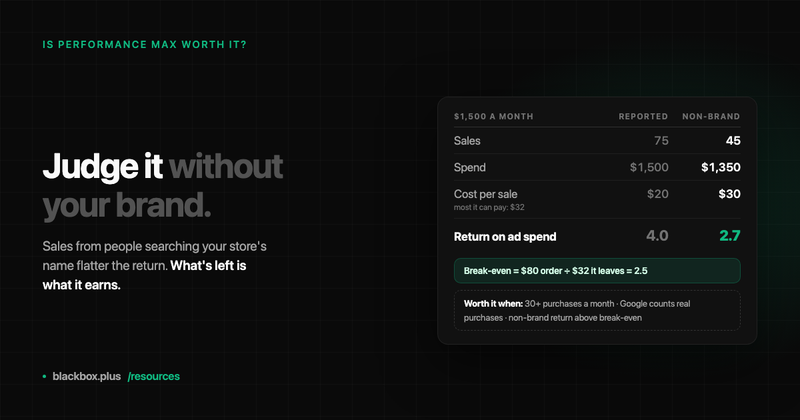
Is Performance Max worth it for a small online store? It is when three things hold: Google counts real purchases, the campaign gets roughly 30 purchases a month to learn from, and its return on sales you wouldn't have had anyway stays above your break-even. If any of the three fails, a Standard Shopping campaign usually does as well and shows you what you're paying for.
The trap is the headline return. Performance Max happily takes searches for your own store's name, people who were going to buy anyway, and those cheap sales can make a break-even campaign look like a winner.
The short version:
- Work out your break-even return first: order value ÷ what an order leaves you before ads.
- Below about 30 purchases a month in the campaign, Performance Max is mostly guessing; Standard Shopping is the safer start.
- Judge it on non-brand sales, not the total, because sales from people searching your name flatter it.
- Count purchases, not days, before you judge, and leave the last few days out of the window.
- Make one change at a time and give it two weeks; a lower target buys more of the dearer clicks, never fewer.
Is Performance Max worth it for a small online store?
It's worth it when it brings sales at a profit that you wouldn't have made without it. To know that, you need your break-even, the campaign's purchase count, and its return with your brand searches taken out.
Here's the example this page uses. A small store sells a $80 order that leaves $32 after product, shipping and fees. So the most it can pay in ads for a sale is $32, and its break-even return on ad spend is $80 ÷ $32 = 2.5. Under 2.5, every sale loses money. (How to work this out for your own store is in how to work out break-even ROAS.)
It spends $50 a day on Performance Max, about $1,500 a month. Google reports a return of 4.0: $6,000 in sales, 75 orders at $20 each. That looks comfortably profitable.
Now take the brand searches out. Say 30 of those 75 orders came from people who typed the store's name, and those clicks cost $150. The other 45 orders cost $1,350, which is $30 each, a return of about 2.7. Still above 2.5, so the campaign earns its keep, but only just. That's the number to manage, not 4.0.
How much data does a Performance Max campaign need?
Roughly 30 purchases a month in the campaign, as a rule of thumb. With fewer, the bidding has too few sales to tell good searches and products from bad ones, and results swing week to week for no clear reason.
Divide your monthly budget by what a sale costs you to see where you stand. The example store's $1,500 at about $20 a sale is 75 purchases, plenty. A store spending $20 a day at $30 a sale gets about 20 a month, which is thin.
Below that line, start with Standard Shopping and move to Performance Max once sales are steady.
How long should I give a PMax campaign before judging it?
Count purchases rather than days. A campaign making 2 sales a day tells you something in a week; one making 2 a week needs a month or more.
Two rules keep you honest:
- Pause a product or campaign only after it has spent two to three times what a sale can cost ($64–$96 for the example store) with no purchase.
- Scale only after 20–30 purchases at or under your target.
Google also books each purchase on the day of the click, not the day of the sale. If your buyers take a few days to decide, the last few days of any report always look worse than they'll end up. Check the "Days to conversion" segment under Conversions, and leave that many days off the end of the window you judge.
After a launch or a big change, give it at least two weeks before the next change.
Which numbers should I look at in Performance Max?
Add these columns and read them over the same window: cost, conversions, conversion value, conversion value ÷ cost (your return) and cost per conversion. Then compare the return with your break-even, not with last month.
Three more views show what the total hides:
- Brand share. In the campaign's Insights, search term insights groups the searches that led to sales. Note how many conversions came from your own brand name, and judge the rest separately.
- Products. The products report shows spend and sales per item, so you can see which ones earn their budget.
- Where the ads ran. Performance Max shows ads on Search, Shopping, YouTube, Display and Gmail. Check how much of the spend went to placements that rarely sell.
Before any of this, make sure the conversions are real: compare Google's purchases with your store's orders for the same dates. A purchase counted twice, or a checkout page view counted as a sale, makes every other number wrong.
Why is my Performance Max ROAS dropping?
Usually because the mix of sales changed, not because the campaign broke. Check these in order:
- Fewer brand sales. If fewer people searched for your name this month, the cheap sales that propped up the return shrank, and what's left is non-brand traffic that costs more per sale. Cost per click up, conversion rate down and no change in where the ads run is the usual sign. Compare the brand share of conversions now with a month ago.
- Dearer clicks in Q4. From mid-November to Christmas more stores bid for the same shoppers. The same sale costs more until January.
- A target set too high. With a fixed target return, Google bids on fewer searches as clicks get pricier. Spend and sales both fall, and the return may hold while the business shrinks.
- Something in the feed or on the site. A price rise, a product out of stock, disapproved items or a slower checkout all show up as fewer sales per click.
In the example, a fall from 4.0 to 2.8 means about 52 sales at $29 each, still under the $32 the store can pay. Worse, but no reason to switch it off.
Why is Performance Max spending on only a few products?
Because it puts money where it has the most proof. Products with a sales history get the budget; the rest get a few clicks and fall behind, even best sellers from other channels.
Before you change the structure, check that the neglected products aren't held back by the feed: disapprovals, missing images, a price far above competitors or low stock.
If they're clean, give them their own room. Move the products you want pushed into a separate campaign, or their own asset group with a listing group for just those items, with its own budget. Then the top two can't take the money first.
Also check why it isn't spending more. If the campaign isn't using its full budget, raising or cutting the budget changes nothing. In Standard Shopping, look at "Search lost IS (rank)": if that jumped, competitors are outbidding you, and only a lower target or a better price helps.
Should I lower my target ROAS?
Lower it only if the campaign is under-spending and your break-even sits comfortably below the new target. A lower target lets Google bid on more searches, and those extra sales cost more each.
A sensible move is to set the target near what the campaign actually gets, never below break-even. For the example store, a 400% target while it reaches 280% starves it; 300% gives it room and stays above 2.5. Change it once, then wait two weeks.
A change also has to beat leaving it alone. If the campaign is above break-even and selling steadily, the safest move is often none.
Performance Max vs Shopping: which should a small store run?
Run Standard Shopping if the store gets fewer than about 30 purchases a month, sells a small catalogue, or wants to see the exact searches it pays for. Run Performance Max once there are enough purchases, a clean feed and a few good images and videos for it to use.
Don't run both for the same products: they compete for the same searches, and you can't tell which one earned a sale. Split the products between them instead, for example best sellers in one and the rest in the other.
If neither clears break-even after these fixes, the problem is usually the margin or the price, not the campaign type. (Running Google Ads for leads instead? See what to check when Google Ads isn't working.)
How Blackbox fits
Blackbox (blackbox.plus) is an AI CMO for small businesses that run their own marketing. Blackbox doesn't build Performance Max campaigns itself (what it creates on Google). Connect your Google Ads account and it reads the campaigns you already run, Performance Max included: spend, clicks, conversions and daily history (connecting Google Ads). It also works out the most a sale can cost from your order value and margin, which is the line to judge those campaigns against, rather than last month's return.
FAQ
Is Performance Max worth it for a small ecommerce store?
Yes, if it gets about 30 purchases a month, Google counts real purchases, and its return on non-brand sales stays above your break-even. Below that, Standard Shopping with a simple bid usually does as well and shows you the searches.
Why is my Performance Max ROAS dropping?
Most often because fewer sales came from people searching your store's name, clicks got dearer in Q4, or the target is set so high that Google bids on fewer searches. Compare the brand share of conversions and the cost per click with a month ago before changing anything.
Why is Performance Max spending all my budget on a few products?
It puts money behind the products with the most sales history. Check the feed for the others first, then give the products you want pushed their own campaign or asset group with its own budget.
How many days should I give a PMax campaign before judging it?
Count purchases, not days: pause only after it has spent two to three times what a sale can cost with nothing to show, and scale after 20–30 purchases at target. Leave the last few days out of any window, because Google books each sale on the day of the click.
Should I use Performance Max or Standard Shopping?
Standard Shopping suits stores with fewer than about 30 purchases a month or a small catalogue. Performance Max suits stores with steady purchases, a clean feed and good images; don't run both for the same products.