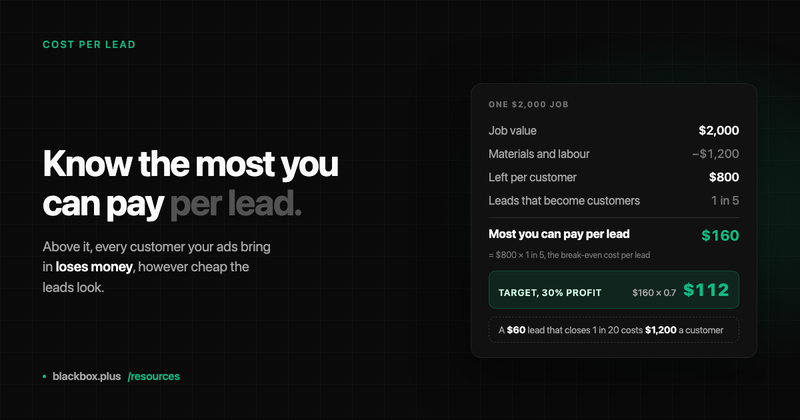
A good cost per lead is any cost per lead below what a lead is worth to your business, and that comes from two numbers you already have: what a customer leaves you after costs, and the share of leads that become customers. If a job leaves you $800 and 1 in 5 leads books, a lead is worth $160. Pay less than that and the ads make money; pay more and every customer they bring in loses it.
Industry averages can't tell you this: a $150 lead is cheap if 1 in 4 close and ruinous if 1 in 20 do.
The short version:
- Cost per lead is ad spend divided by the leads it brought in, over the same dates.
- Your ceiling is what a customer leaves you × the share of leads that become customers.
- Set your target about 30% below the ceiling so the ads leave profit, not just break even.
- Judge a lead cost against your ceiling, not against last month or an industry table.
- Report cost per customer next to cost per lead; it's the number that pays the bills.
Cost per lead calculator
What a customer is worth, the share of leads that become customers, and what you pay per lead now.
- Break-even cost per lead
- $160
- Target (keep 30%)
- $112
- Your cost per customer
- $500
A customer leaves $800, so a lead is worth at most $160. At or under target: the ads leave a profit.
What is a good cost per lead?
A good cost per lead is one below your break-even cost per lead, the point where the customers your leads turn into exactly pay for the ads. Anything under it makes money, and the further under, the more.
Here's the example this page uses throughout. A home-repair business has an average job of $2,000. After materials and labour, a job leaves 40%, so each customer is worth $800 before ads. Of the last 100 leads, 20 became paying customers: 1 in 5.
- Break-even cost per lead = $800 × 0.2 = $160
- Target cost per lead, keeping 30% of that margin as profit = $800 × 0.7 × 0.2 = $112
So $112 is the target and $160 the ceiling. A $95 lead is good, a $140 lead still makes a little money, and a $180 lead loses $20 every time.
Why industry averages don't answer it
Average cost per lead by industry tables mix businesses with different prices, margins and close rates, so they can't say whether your $90 is profitable. Use them only to sanity-check a new campaign before you have numbers of your own.
For that sanity check, one widely quoted survey of about 250 US marketing and sales teams (WebFX, across all lead-generation channels) puts average cost per lead at roughly:
- $30–55 for non-profits, retail, telecoms and education
- $100–110 for marketing, consumer products, travel and media
- $130–160 for business services, finance and healthcare
- About $210 for technology
A $150 lead is cheap for a business that closes 1 in 4 and ruinous for one that closes 1 in 20, whatever the table says. Work out your own ceiling below and judge against that.
How do you calculate cost per lead?
Cost per lead is what you spent on ads divided by the leads they produced, over the same dates. Spend $1,500 in a month, get 15 leads, and your cost per lead is $100.
Three things make the number trustworthy:
- Count real leads. A lead is a person who asked for a quote, booked a call or filled in a form with real details. Leave out spam, duplicates and wrong numbers, even if the ad platform counts them.
- Use the same window for both. Spend from one month and leads from another make the number meaningless.
- Calculate it per campaign or source. An account-wide average hides the campaign that's doing all the work and the one that's burning the budget.
How do you work out the most you can pay per lead?
Multiply what a customer leaves you by the share of leads that become customers. That's your break-even cost per lead, the ceiling; then set your target below it.
- Work out what a customer leaves you. Take your average job or order value and subtract what it costs to deliver: materials, labour, subcontractors, fees. Leave out rent and other fixed costs; they don't change with one more customer.
- Count your close rate from your own leads. Take your last 50–100 leads and count how many paid. Use your inbox, call log or a spreadsheet, not the ad platform's guess.
- Multiply the two. $800 × 1 in 5 = $160. That's the most you can pay per lead and break even.
- Set a target below it. Decide how much of each customer's margin you want to keep as profit after ads. Keeping 30% gives $112 here.
- Recalculate when prices, costs or close rate change. The ceiling moves with the business, not the auction.
If you sell online rather than book jobs, the same thinking gives you a break-even cost per sale; see how to work out break-even ROAS.
Should you use lifetime value to set your cost per lead?
Use first-year profit, not lifetime value, unless your own records show customers coming back. The ad money leaves today; repeat work arrives later, if at all.
If your records do show repeat work, add it. Say 1 in 3 customers books a second job within a year, leaving another $800. A customer is then worth about $1,067 in the first year, and the ceiling rises from $160 to about $213. Without that history, judge on the first job.
Why can a cheap lead lose money?
A cheap lead loses money when few of those leads become customers. What matters is the cost per customer: cost per lead divided by the share of leads that close.
Compare two campaigns for the same business:
- Campaign A: $60 a lead, 1 in 20 close. Each customer costs $1,200 in ads, against the $800 a customer leaves. It loses $400 on every customer.
- Campaign B: $150 a lead, 1 in 4 close. Each customer costs $600. It makes $200 on every customer.
The cheap campaign is the expensive one. This is why close rate has to be measured per campaign or source. A Meta instant form often brings cheaper leads than a website form, and a lower share of them pick up the phone. Work out the ceiling for each source with its own close rate: at 1 in 20, Campaign A's ceiling is just $40.
My cost per lead went up. Should I stop the ads?
Not if it's still under your ceiling. A cost per lead that rose 40% from $80 to $112 is still at target for the example business, and well under the $160 ceiling. That's a cost to work on, not a reason to switch off a campaign that makes money.
Before you change anything, find out why it rose:
- Check the market or the account. Compare cost per click and the share of clicks that become leads with the same weeks last year. Dearer clicks at the same conversion rate is usually the market. Fewer leads per click points at your page, form or ads.
- Wait for enough leads. Judge on at least 30 leads, or a full month on a small budget. At $1,500 a month and $100 a lead, that's two months, not a bad week.
- Change one thing at a time. If you raise the budget and change the ads in the same week, you won't know which one moved the number.
Stop a campaign only when its cost per customer stays above what a customer leaves you for a full sales cycle, after the obvious fixes. If your Google leads are slowing as well as getting dearer, work through what to check when Google Ads isn't working.
How do you raise what a lead is worth?
Raise your close rate. It's usually the biggest lever, and it sits outside the ad account.
- Call back fast. A lead who hears from you within minutes is still thinking about the problem. One who hears tomorrow has often booked someone else.
- Follow up more than once. Many leads who don't answer the first call answer the second or third.
- Make the offer easy to say yes to. A price range or a free site visit closes more than "get in touch".
If faster follow-up lifts the close rate from 1 in 5 to 1 in 4, the ceiling goes from $160 to $200 without changing the ads at all. Keeping every lead and its follow-up in one list helps; see how to manage leads from your ads.
What should you report instead of cost per lead?
Report cost per customer next to cost per lead. Cost per lead tells you what the ads charged; cost per customer tells you whether the business got its money back.
A spreadsheet with each lead's date, campaign and whether it became a customer is enough. Once a month, divide each campaign's spend by the customers it produced.
When you have real volume, roughly 30 or more closed customers a month, you can send closed deals back to Google or Meta as offline conversions so the platform learns which leads pay. Below that, keep the form fill or call as the conversion the campaign optimizes for, and judge it by cost per customer yourself.
How Blackbox uses your break-even
Blackbox (blackbox.plus) is an AI CMO for small businesses that run their own marketing. When Blackbox builds a campaign, it shows the break-even per result beside the budget, from your order value and margin, and you can edit both (creating a Facebook ad campaign). It asks what a customer is worth when it builds your strategy (the strategy questions), and every budget or pause suggestion has to beat leaving things as they are before it reaches you. Collecting leads on Meta? See the Facebook lead ads guide.
FAQ
What is a good cost per lead for a small business?
A good cost per lead is any amount below what a lead is worth to you: what a customer leaves after costs, multiplied by the share of leads that become customers. For a $2,000 job at 40% margin with 1 in 5 leads closing, that's $160. Aim about 30% under it, around $110, to keep a profit.
How do I calculate the most I can pay per lead?
Take what one customer leaves you after delivery costs, and multiply it by your close rate from your last 50–100 leads. That's your break-even cost per lead. Set your target below it by the share of profit you want to keep.
Is a $100 cost per lead too high?
Only if a lead is worth less than $100 to you. If a customer leaves you $800 and 1 in 5 leads closes, $100 is well under the $160 ceiling and profitable. If 1 in 20 closes, the ceiling is $40 and $100 loses money.
My cost per lead went up 40%, should I stop my ads?
Not if it's still under your break-even cost per lead. Check whether click costs rose or fewer clicks became leads, and judge on at least 30 leads. Stop only when cost per customer stays above what a customer leaves you for a full sales cycle.
What's the difference between cost per lead and cost per customer?
Cost per lead is ad spend divided by the leads you got; cost per customer divides it by the leads that paid. Cost per customer tells you whether the ads make money, because a cheap lead that never closes costs more than a dear one that does.